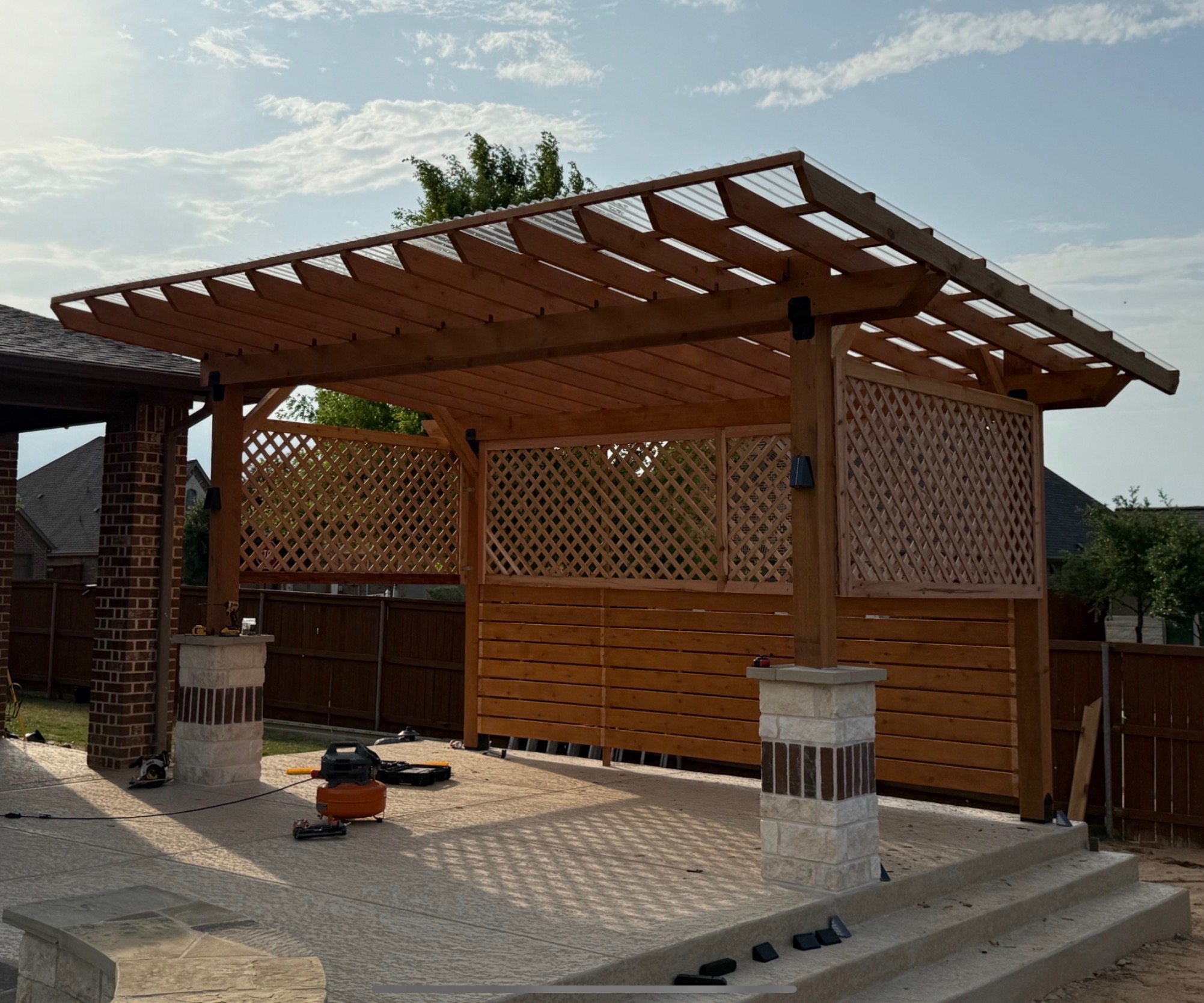
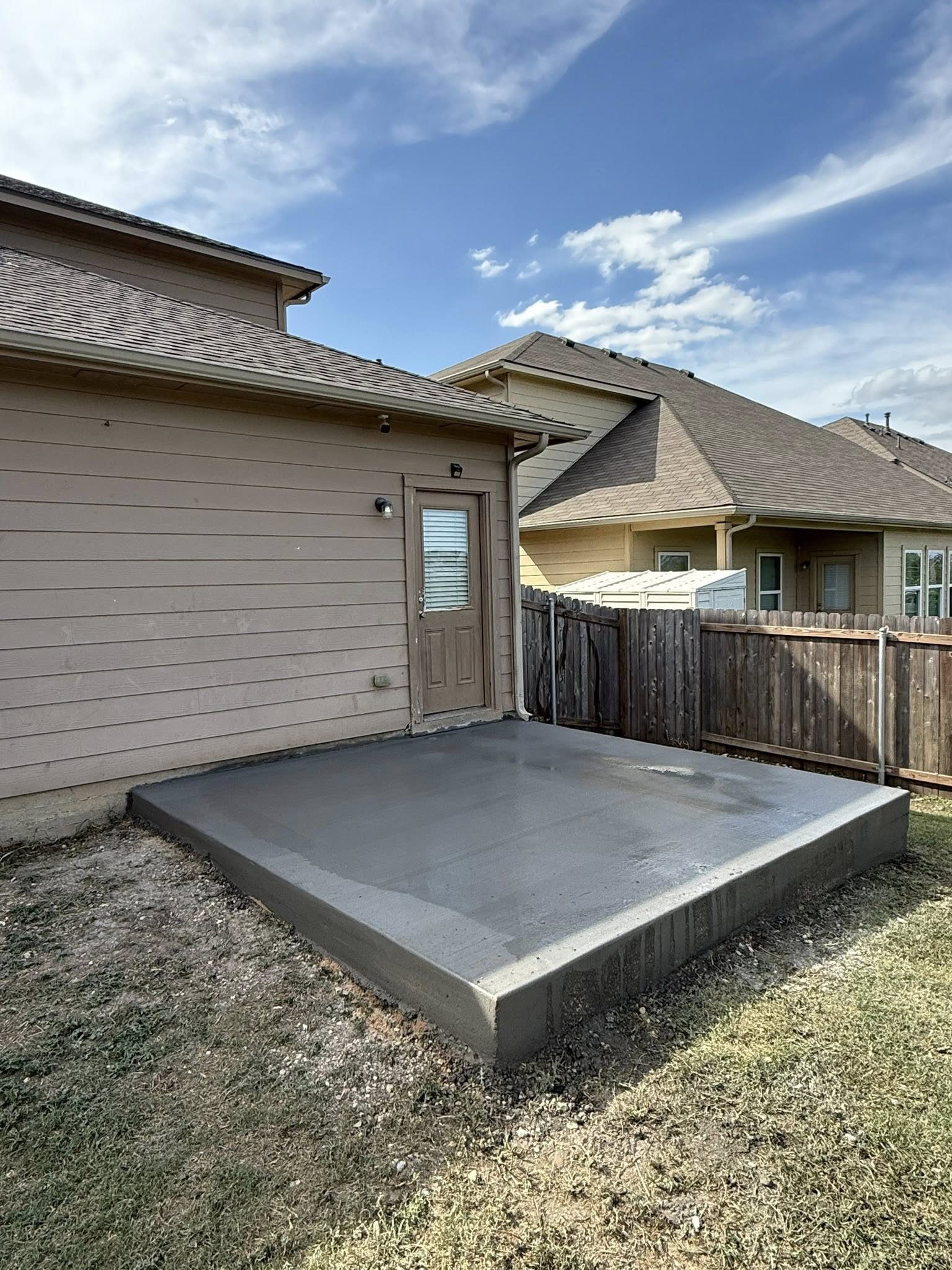
A concrete patio is one of the most-requested hardscape jobs we do in Austin, and the one where pricing varies wildest between contractors. Quotes for the same 400-square-foot patio can range from $3,000 to $8,000 depending on who you call, what's actually in the bid, and how much corner-cutting they're planning to do.
Here's what a concrete patio actually costs in Austin in 2026, what changes the number, and how to spot the cheap quote that's going to crack in two years.
The short answer: real Austin concrete patio pricing in 2026
Most concrete patios in greater Austin fall into one of these ranges. These are total installed prices, including site prep, grading, forming, reinforcement, concrete pour, finish work, and cleanup:
| Patio type | Per square foot, installed | Typical 400 sqft patio |
|---|---|---|
| Standard broom-finish concrete | $8 to $15 | $3,200 to $6,000 |
| Stained concrete (acid or water-based) | $13 to $20 | $5,200 to $8,000 |
| Stamped concrete (any pattern) | $15 to $25 | $6,000 to $10,000 |
| Stamped + stained / decorative finish | $18 to $30 | $7,200 to $12,000 |
| Exposed aggregate | $12 to $20 | $4,800 to $8,000 |
For larger patios (600 to 1,000+ square feet), the per-foot price drops slightly because mobilization is a fixed cost spread across more area. For smaller patios (under 200 square feet), the per-foot price often rises 15 to 25 percent for the same reason. If a contractor quotes you well below the low end of these ranges, something is missing from the scope. Ask hard questions about concrete thickness, rebar, and the prep work.
Want a real number for your patio? Send us a rough size and shape and we'll come walk the project, check the grade, and write up an honest, line-itemed quote. Free, no obligation.
Get my patio quote →What actually drives the price up (or down)
1. Thickness and reinforcement
The minimum for a residential patio is 4 inches thick with #3 rebar on 18-inch centers (or 6x6 welded wire mesh). The cheap pour you're getting a $3,000 quote for is often 3 inches thick with no rebar. That patio will crack within 2 to 5 years, especially in Austin's expansive clay soil. We pour 4 inches minimum (5 to 6 inches for areas that will support a structure like a pergola or outdoor kitchen) and include rebar on every job.
2. Site prep and grading
Concrete sits on what's underneath it. In Austin, that usually means clay soil that swells and shrinks with the seasons. Proper prep includes excavating 4 to 6 inches below grade, compacting the subgrade, putting down 2 to 4 inches of crushed limestone base, and compacting that. A 400-square-foot patio has $400 to $1,200 of prep work in it that you'll never see but absolutely need.
3. Forming and finish complexity
Square patios are cheapest. Curves, multiple levels, and patios that wrap around existing features (trees, steps, a pool) cost more because forming takes longer. A simple rectangle might run $9 per square foot. The same square footage in a kidney shape with built-in steps might run $14.
4. Decorative finishes
A broom finish (the standard look, slightly textured, mostly grey) is the cheapest finish and works fine for most homes. Stained concrete (acid or water-based dye) costs $4 to $7 more per square foot but lets you match the patio to the home's color palette. Stamped concrete (patterns that mimic flagstone, brick, slate, or wood) costs $6 to $12 more per square foot and is where most "upgrade" budgets go.
5. Drainage
A patio needs to slope away from the house at minimum 1/8 inch per foot (preferably 1/4). For larger patios or patios in low spots, we sometimes install a French drain or surface drain to move water away from the foundation. That adds $400 to $1,500 depending on length and complexity.
6. Site access and demo
If our concrete truck can pull right up to the pour, that's the cheapest scenario. If we have to wheelbarrow concrete 80 feet through a side gate, labor doubles. If we have to remove an old patio first, demo and haul-off runs $2 to $5 per square foot. If we have to take out a retaining wall, an old slab, or significant landscaping to get access, that's its own line item.
Concrete vs. pavers vs. flagstone: an honest comparison
Standard poured concrete
The most-installed patio material in Austin and the most cost-effective. Lasts 30+ years if poured correctly. Easy to clean. Won't shift or settle individually like pavers can. The downsides: when it cracks, the whole slab cracks (we install control joints every 8 to 10 feet to manage where cracks happen). And it's harder to repair invisibly than pavers, where you can pull and replace a single stone.
Stamped or stained concrete
Same durability and lifespan as standard concrete, but with the visual variety of pavers or natural stone. Stamped flagstone-look concrete can be hard to tell from real flagstone at 10 feet. Costs 50 to 100 percent more than broom finish, but a fraction of real flagstone. The catch: stamped concrete shows wear differently than plain concrete, and the surface sealer needs reapplying every 3 to 5 years to keep the color vibrant.
Concrete pavers
Interlocking concrete pavers (the kind you see in driveways and patios), $14 to $24 per square foot installed. Cost more upfront, but offer real advantages: any single paver can be pulled and replaced, drainage is better between joints, and there's no "the whole slab cracked" failure mode. Pavers do shift slightly over time (a few millimeters here and there) and need re-sanded every 5 to 8 years.
Natural flagstone
Real limestone, sandstone, or slate flagstone laid on a concrete base or sand base. $20 to $40 per square foot installed depending on the stone. The most premium look, real Hill Country character. Trade-offs: irregular surface (not great for furniture stability), needs sealing to resist Texas summer stains, and labor-intensive to install. Beautiful where it belongs.
Travertine or natural stone tile
Polished or tumbled natural stone tiles in regular shapes. $18 to $30 per square foot installed. A premium look on the right architecture, often used around pools because travertine stays relatively cool in direct sun. Heat-resistance is real (we get asked about this constantly for pool decks in Austin's 100-degree summers).
Add-ons and what they actually cost
- Control joints (crack-management cuts): included on every install at no extra charge. We use saw-cut joints every 8 to 10 feet to direct cracks.
- Color additive in the mix (integrally colored concrete): $1.50 to $3.50 per square foot. Cheaper alternative to staining for a uniform color.
- Sealer (recommended for stamped and stained): $0.50 to $1.50 per square foot per application. Plan to reseal every 3 to 5 years.
- Steps or seat walls in the same pour: $80 to $200 per linear foot.
- Permanent fire pit or fire feature integrated into the patio: $1,800 to $6,000 depending on style.
- Conduit for outdoor outlets, lighting, gas: $200 to $600 to rough in during the pour.
- Footings for a future pergola or patio cover: $400 to $1,200 to install at pour time, much cheaper than retrofitting later.
How long does a concrete patio install take?
Most residential concrete patios are poured in 1 day after 1 to 2 days of prep (excavation, grading, base, forming, reinforcement). After the pour, concrete needs 5 to 7 days of light curing before normal foot traffic and 28 days to reach full strength. We typically tell clients the patio is fully usable in a week, and "drive a car on it" usable in a month.
Stamped or stained finishes can add 1 to 3 days for the finish work. If we're sealing afterward, add another day for that to dry.
How to save money without buying yourself a problem
- Keep the shape simple. A rectangle is significantly cheaper than the same square footage in a curved kidney or wraparound shape.
- Skip the integrally-colored mix. If you're set on color, stain it after the pour. Same look, often less money, and stain doesn't fade with sun the way some integral colors can.
- Get the structural stuff right. Don't save money on thickness or rebar. Those are the line items that determine whether your patio is here in 20 years.
- Bundle the patio with other work. If you're building a deck, a pergola, or hardscape walkway, putting it all on one mobilization saves real money on truck fees, crew time, and concrete delivery.
- Pour footings now if you might add a pergola later. $800 of footings during the patio pour is much cheaper than $3,500 of post bases retrofitted after the fact.
- Pick broom finish over stamped if you want to spend the money on size instead. A larger broom-finish patio often beats a smaller stamped patio for actual usability.
How to spot a quote that's too cheap
If a contractor quotes you 30 percent below the ranges in this guide, ask:
- How thick is the pour? (Should be 4 inches minimum, 5+ if loading is heavy.)
- What reinforcement is included? (Should be #3 rebar on 18-inch centers OR 6x6 welded wire mesh.)
- What's the base prep? (Should be 2 to 4 inches of compacted crushed limestone over compacted subgrade.)
- Where are the control joints? (Should be every 8 to 10 feet.)
- How is drainage handled? (Should slope away from house at 1/8 to 1/4 inch per foot.)
- Is demo and haul-off included? (If you're replacing an old patio.)
- Is the cleanup included? (Should be.)
If the contractor can't answer those questions specifically, the quote that looks cheaper today is going to be a crack-and-spall problem in 3 to 5 years. The concrete you can't see (the rebar, the base, the thickness) is the concrete that matters.
Want a real patio quote? We come walk the project, check the grade, and write up an honest, line-itemed price. No mystery numbers, no surprises later.
Get my patio quote →The bottom line
A standard 400-square-foot broom-finish concrete patio in Austin will cost you somewhere between $3,200 and $6,000 in 2026. Stamped or stained finishes push that to $6,000 to $12,000. The biggest cost drivers are size, finish, and access. The biggest quality drivers are the thickness, the rebar, and the base prep, all of which are invisible the moment the pour cures.
The cheapest concrete patio in Austin is a real concrete patio installed once. The most expensive is the cheap one you pay for again in five years.