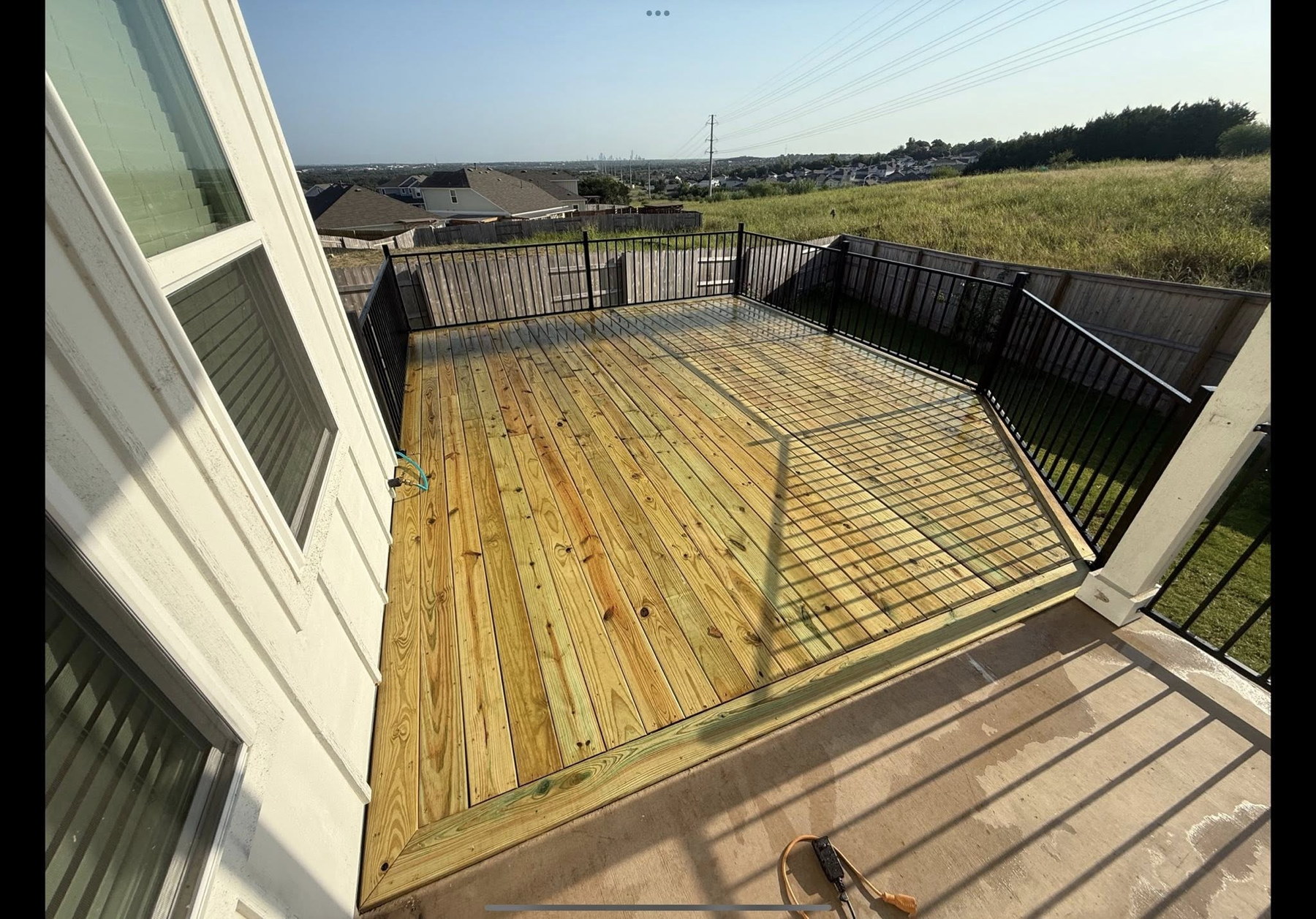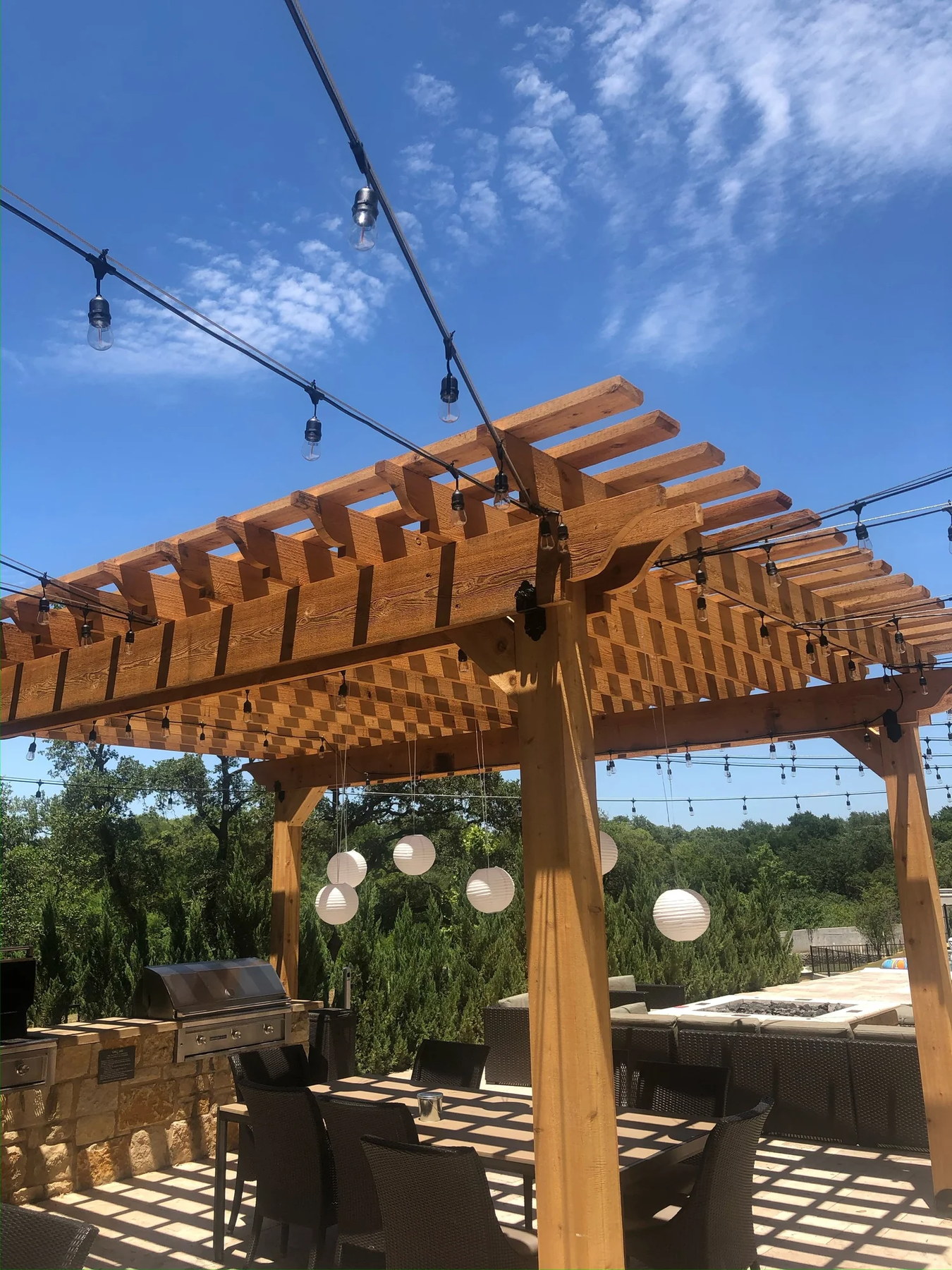
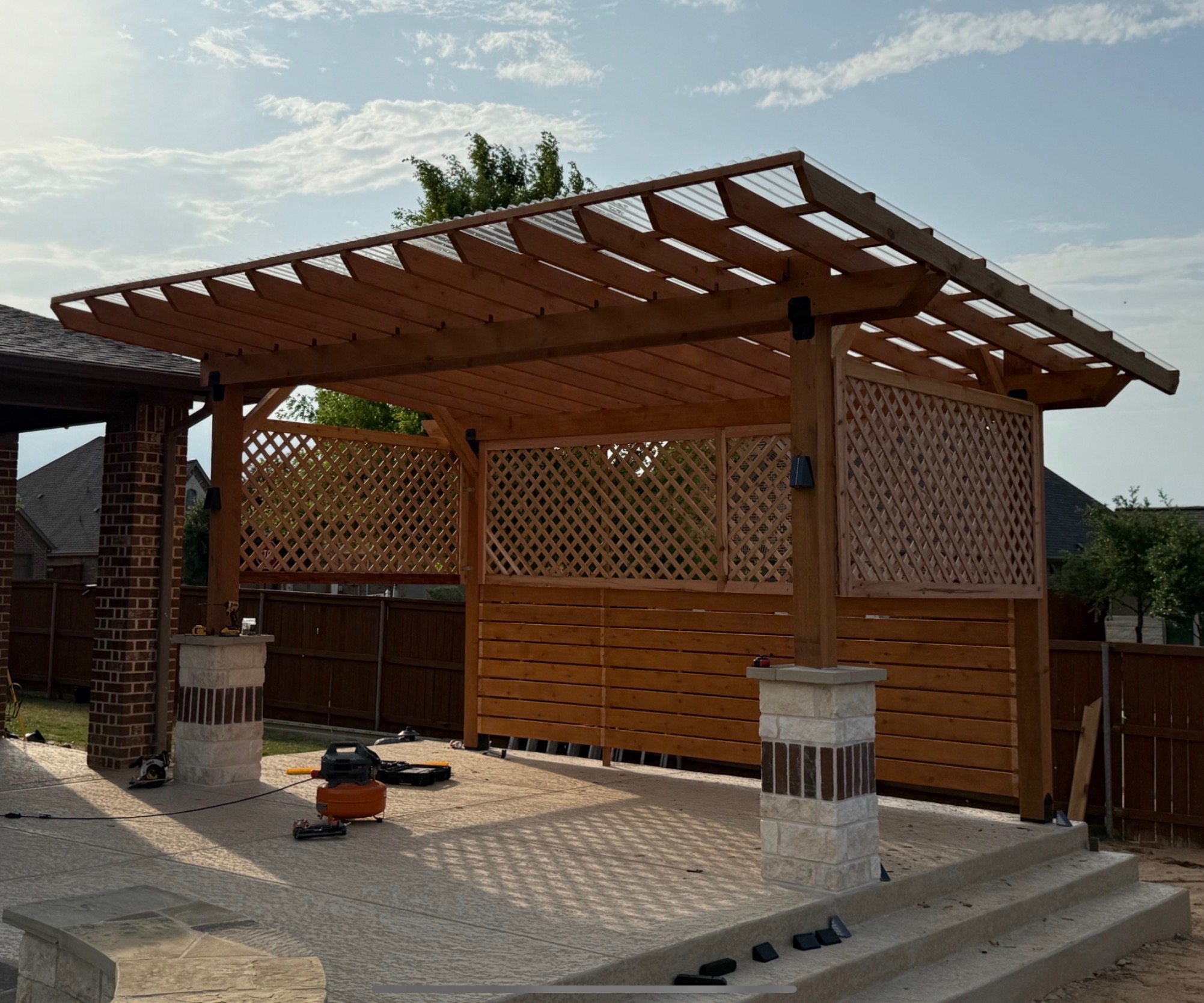
A good pergola changes how you use your backyard. The bad ones rot, sag, or fade within a few summers. The difference is rarely the design. It's almost always the lumber, the framing, and the contractor.
Here is what a cedar pergola actually costs in Austin in 2026, what changes the price, and how to spot a quote that will hold up in Texas heat for the next 25 years.
The short answer: real Austin pergola pricing in 2026
Most cedar pergola builds in greater Austin fall into one of three buckets, depending on the size, whether it's open-top or covered, and whether it's attached to the home. These are total installed prices (materials, labor, footings, hardware, demo, and cleanup):
| Pergola type | Typical 12x12 size | Typical 14x16 to 16x20 |
|---|---|---|
| Freestanding open-top cedar | $8,500 to $13,000 | $13,500 to $22,000 |
| Attached patio cover (open-top) | $10,500 to $16,000 | $16,500 to $26,000 |
| Solid-roof patio cover (cedar & shingle or metal) | $14,500 to $22,000 | $22,500 to $38,000 |
These ranges are what we are actually quoting customers in Austin, Round Rock, Cedar Park, Dripping Springs, Lakeway, Buda, and Kyle right now. If a contractor quotes you well below the low end, ask hard questions about post depth, the size of the beams, the hardware they're using, and whether they're real cedar or pressure-treated with a cedar stain. There's a real difference.
Want a real number for your pergola? Use our free Design Builder. Pick the size, material, and add-ons. We'll get back to you as soon as we can with a line-itemed quote. No fees, no obligation.
Design my pergola →What actually drives the price up (or down)
1. Open-top vs. covered (the biggest variable)
An open-top cedar pergola is essentially posts, beams, and decorative slats overhead. A solid-roof patio cover adds rafters, sheathing, roofing material (shingle, metal, or polycarbonate), and often gutters. That's an extra $4,000 to $15,000 depending on size and what you put on top. In Austin's heat, a solid roof is genuinely useful 5+ months of the year. An open top is more about defining the space.
2. Freestanding vs. attached
An attached patio cover is a structure that ties into your home's framing or roofline. It almost always needs a permit, often needs an engineer's stamp, and requires flashing to keep water away from the house. Attached covers usually cost $1,500 to $4,000 more than the equivalent freestanding pergola because of that work.
3. Size and post count
Pergolas scale with size, but not linearly. A 14x16 pergola has only 35 percent more area than a 12x12, but it usually needs bigger beams to span the longer distance without sagging, which means more lumber. Once you go past about 16 feet in any direction, you're often looking at 6x12 or 6x14 beams, which are noticeably more expensive than the 6x8 or 6x10 beams used on smaller builds.
4. Cedar grade and lumber source
"Cedar" is not one thing. The most common pergola lumber in Texas is Western Red Cedar, but it comes in several grades. The grade most contractors use, knotty #2 Common, runs about $3.50 to $5.50 per board-foot in 2026. Clear-grade cedar (no knots, premium look) can run double that. We use #2 Common kiln-dried cedar on most builds because it looks great, holds up well, and doesn't punish you with an extra $4,000 on the quote.
5. Footings and Austin's caliche
Posts on a pergola need real footings, especially if it's a patio cover that carries weight. In most of Austin, that means digging through caliche (soft limestone) at least 24 to 36 inches down, often into bedrock. Auger work and concrete add $150 to $400 per post. A 6-post pergola has $900 to $2,400 of footing work in it that you never see.
6. Hardware (the part nobody talks about)
The brackets, post bases, and connectors that hold a pergola together are the difference between a structure that lasts 30 years and one that wobbles in five. We use hot-dipped galvanized or stainless steel hardware on every build, sized for the actual wind load. Cheap hardware looks the same on day one. It doesn't five years in.
Cedar vs. aluminum vs. pressure-treated: what we recommend
Western Red Cedar
The most-requested pergola material in Austin and our go-to for outdoor living. Naturally resists rot, bugs, and weathering. Smells incredible when it's freshly cut. Weathers to a soft silver-grey if you let it, or you can stain it and keep that warm reddish-brown for years with a coat every 3 to 5 years. Lasts 25 to 30 years in our climate. Cedar pergolas just look right next to a Hill Country home.
Aluminum (Big Kahuna, StruXure, etc.)
Aluminum pergolas, especially louvered systems that open and close, have gotten popular fast. They look modern, last 40+ years, and need essentially zero maintenance. The trade-off is cost (usually 60 to 120 percent more than cedar) and aesthetic. Aluminum looks great with a modern home and somewhat out of place next to a ranch or farmhouse. Powder-coated finishes hold up well to Austin sun, but the louvered motors and controllers are points of failure that cedar doesn't have.
Pressure-treated pine
You can build a pergola out of pressure-treated lumber, and it's the cheapest option (usually 25 to 40 percent less than cedar). PT will swell and shrink with the humidity more than cedar does, which means small splits and a slightly rougher look over time. If you're planning to paint it (white or dark stain) and you're okay with re-coating every 2 to 3 years, PT is a fair option. If you want it to look natural, stick with cedar.
Add-ons and what they actually cost
The base pergola is the headline number. These are the upgrades that come up on almost every quote, with rough 2026 numbers:
- Stained finish (vs. raw weathering): $600 to $1,800 depending on size and stain brand.
- Recessed LED lighting in the beams: $400 to $1,500 for a basic setup, more if you want zones or color control.
- Ceiling fan wiring and install: $400 to $900 if there's an existing electrical run nearby, $800 to $1,800 if we have to trench new wiring.
- Tongue-and-groove ceiling under a solid-roof cover: $12 to $25 per square foot installed. A 14x16 T&G ceiling runs $2,700 to $5,600. It's the upgrade that makes a patio cover look finished instead of utilitarian.
- Polycarbonate clear-roof panels (lets light through but blocks rain): $9 to $16 per square foot, plus framing.
- Curtains or roll-down screens for wind/sun: $1,200 to $3,500 depending on length and style.
- Outdoor outlets (for TV, speakers, string lights): $200 to $450 per location.
- Privacy screen wall on one side (slatted cedar): $40 to $80 per linear foot.
How to save money without ending up with a problem
- Start with the right size. A 12x12 pergola is plenty for a 6-person dining setup. Bigger isn't always better. Don't pay for a 16x20 if you'll furnish it like a 12x12.
- Skip the louvered roof. Motorized louver systems look cool but add $8,000 to $20,000 vs. a simple open top with strategically placed shade sails or screens.
- Bundle electrical. Running outlets, fan wiring, and lighting on the same trench saves $400 to $1,200 vs. doing each as separate trips.
- Pick #2 Common cedar, not clear cedar. Almost no one will notice the knots once it's stained. You'll save $1,500 to $4,000 on the lumber.
- Don't cheap out on the framing. Beam size, post depth, and hardware are the parts nobody sees and the parts that fail first. That's not where to save $300.
- Bundle related work. If you're also building a deck, a fence, or hardscape, doing it in one mobilization saves real money on dump fees, crew time, and concrete.
How long does a pergola build take?
Most cedar pergolas take 4 to 8 working days from the day the crew shows up. A 12x12 freestanding open-top can be done in a week. A solid-roof patio cover with electrical, ceiling fans, and a stained finish runs 2 to 3 weeks. Permits in Austin add another 1 to 4 weeks before we can start, depending on your jurisdiction. We pull every permit ourselves and never start without one.
Do you need a permit for a pergola in Austin?
It depends on three things: how big it is, whether it's attached to the house, and which jurisdiction you're in. The general rules:
- City of Austin: Most freestanding pergolas over 200 square feet need a permit. Attached patio covers almost always do, regardless of size.
- Round Rock, Cedar Park, Lakeway, Pflugerville: Each has slightly different thresholds. Attached structures almost always need permits. Open-top pergolas over a certain size usually do too.
- Hays County (Buda, Kyle, Dripping Springs): County permitting is generally lighter than the city, but HOAs are heavier. You're more likely to need HOA architectural approval than a county permit.
We handle the permit work as part of the job. That's not an extra fee, it's how we work.
When should you start the conversation?
For a summer pergola, you want to be talking to a contractor in February or March. Spring permitting runs slow in Austin, and the good crews book out by April. Fall installs (September and October) often have shorter lead times and the weather is honestly nicer for the crew. The middle of summer is doable, but you'll be working around 100-degree afternoons.
Ready for a real number? Use the Design Builder to pick your size, material, and add-ons. We'll get back to you as soon as we can with a free quote.
Design my pergola →The bottom line
A real cedar pergola in Austin starts around $8,500 for a smaller freestanding open-top and runs into the $20,000s for a covered patio with the upgrades that make it feel like a real outdoor room. The biggest cost drivers are size, whether it's covered, and the add-ons. The biggest quality drivers are the lumber grade, the footings, and the hardware.
If you're trying to figure out whether a quote you got from another contractor is fair, here's a quick gut-check: ask them what size beams they're using, how deep the post footings go, and what brand of hardware they're using. If they hesitate, that tells you something. If they answer specifically (with numbers and brand names), you're probably in good hands.