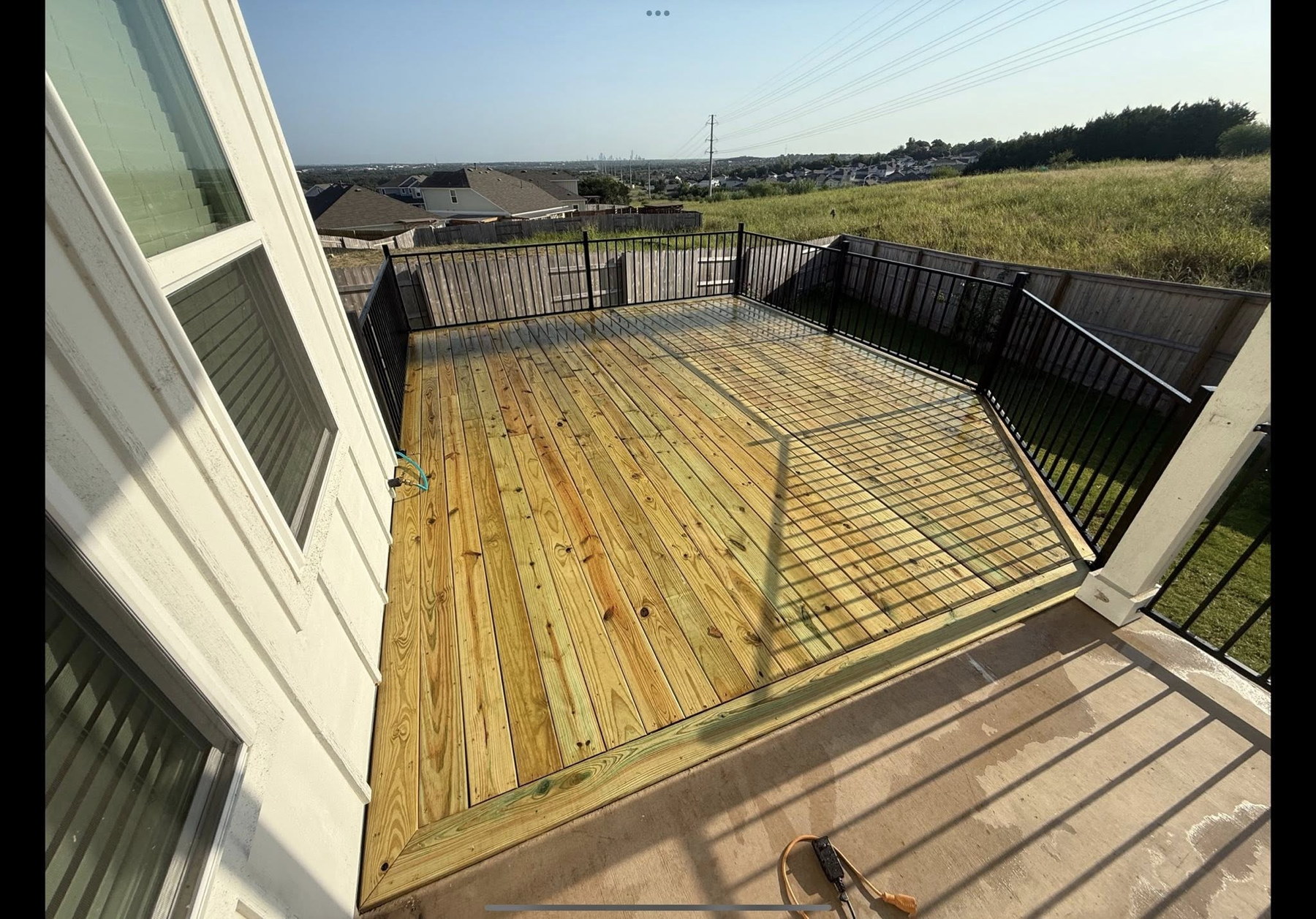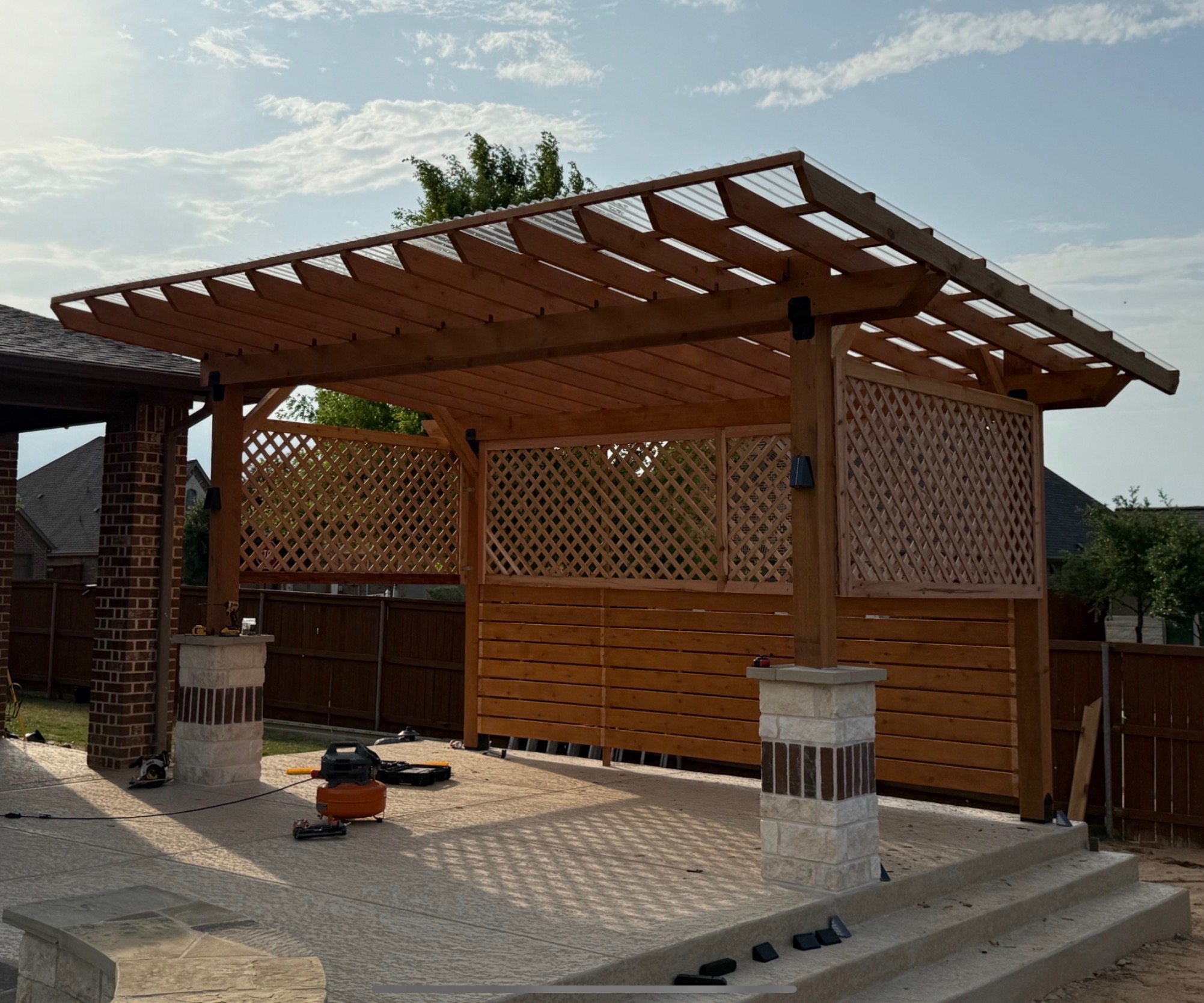
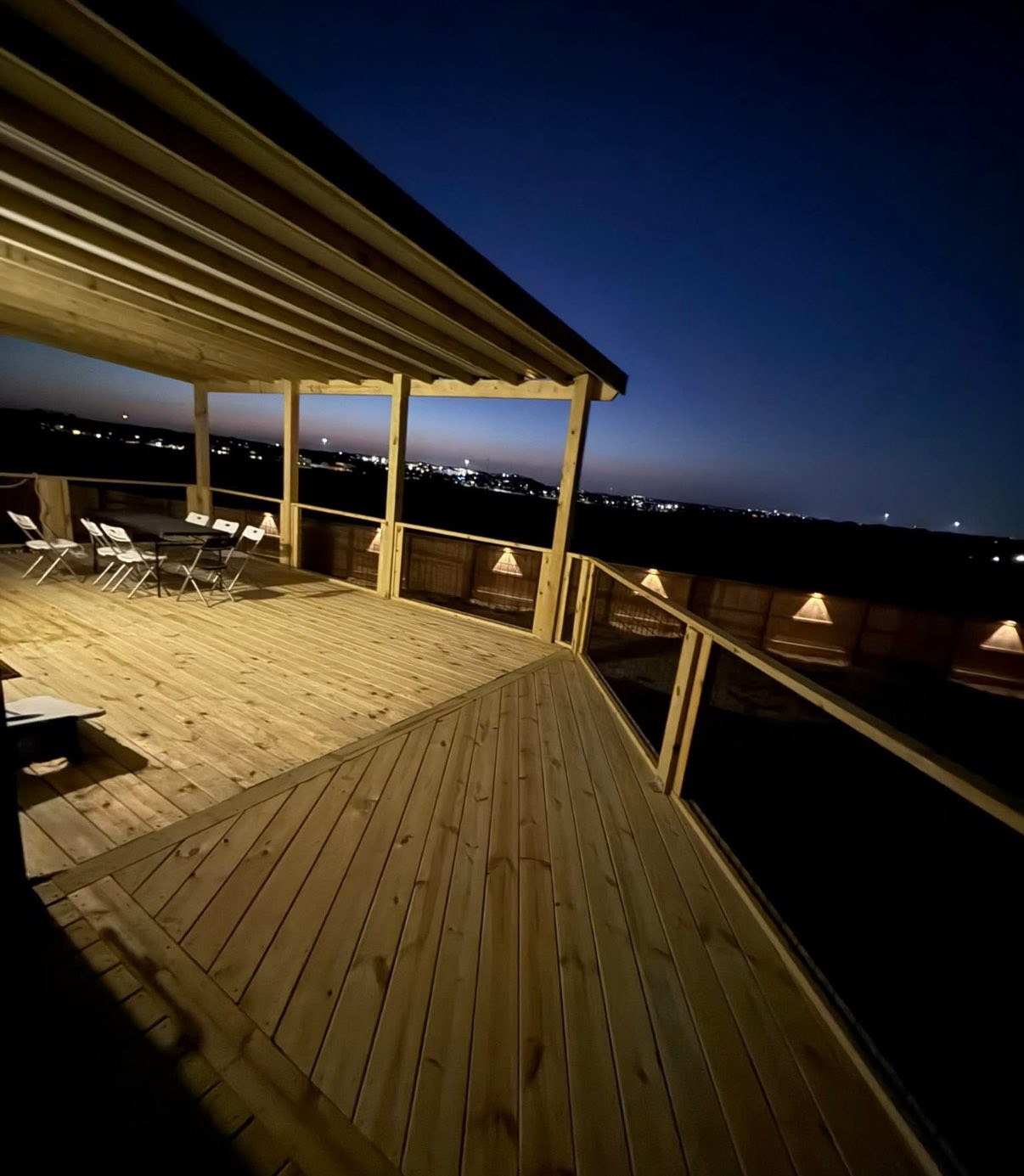
This is the question we get on roughly half of our deck consultations: "if we put this in, will we get our money back when we sell?" The honest answer is yes, more than most home improvements, and in many Austin neighborhoods it's actually one of the best returns you can buy. But the detail matters, and the wrong deck on the wrong house can actively cost you at resale.
Here's what a new deck, pergola, or outdoor living build actually does to your Austin home value, with real numbers.
The short answer: deck ROI in the Austin market
A well-built deck in Austin typically recoups 70 to 100 percent of its cost at resale. That's strong by any measure. For comparison, here's where decks and outdoor living rank against other common Austin home improvements:
| Home improvement | Typical cost recouped at resale | Notes |
|---|---|---|
| Garage door replacement | 95% to 110% | Highest-ROI improvement in most markets. Cheap and visible. |
| Manufactured stone veneer (front facade) | 85% to 105% | Curb appeal driver. Big visual impact for the dollars. |
| Wood deck (cedar or PT) | 75% to 100% | Adds functional outdoor square footage Austin buyers value. |
| Composite deck | 70% to 95% | Premium material, smaller relative percentage but bigger absolute dollar return. |
| Minor kitchen update | 70% to 85% | Counters, hardware, paint, lighting (not a full remodel). |
| Covered patio or pergola | 55% to 80% | Higher when integrated with existing deck, lower as standalone. |
| Outdoor kitchen | 55% to 75% | Better as functional benefit than as resale play. |
| Major kitchen remodel | 50% to 65% | Big absolute dollars but lower percentage return. |
| Bathroom remodel | 50% to 60% | Similar story to kitchen remodel. |
| Pool installation | 30% to 50% | Often considered a maintenance liability by Austin buyers. |
That's why decks, pergolas, and outdoor living are some of the most-quoted projects in Austin: they consistently rank in the top tier for return, and they meaningfully improve the years you live in the home before you sell.
Want a deck quote that actually pencils out at resale? Tell us about your home and yard, and we'll come walk it and write up an honest, line-itemed quote with materials we know will hold value.
Get my deck quote →Why decks specifically perform so well
The reason decks beat kitchens and bathrooms on percentage return isn't because they're more valuable in absolute dollars. It's because of the math. A $35,000 deck recouping 80 percent ($28,000 at resale) is better return than a $70,000 kitchen remodel recouping 60 percent ($42,000 at resale). The kitchen made you more total dollars, but the deck made you a higher percentage and cost half as much to build.
There's also a buyer-perception piece. Most Austin home shoppers walk through a backyard with a real deck or covered patio and mentally add that to "outdoor square footage I'd use." They walk through a recently remodeled kitchen and mentally check the box "kitchen, fine." The deck creates emotional weight in the listing photos and the showing. The kitchen is table stakes.
Which deck materials hold value best at resale
Composite (Trex, TimberTech, Fiberon)
Strongest value-holding material. Won't rot, warp, or splinter. No staining required. Most premium boards carry 25-year warranties that explicitly transfer to a buyer. In a listing description, "low-maintenance composite deck" is a real selling point. Composite costs more up front (50 to 100 percent more than pressure-treated) but the absolute dollar return is larger and the perceived buyer benefit is stronger.
Western Red Cedar
The best balance of beauty and value for most Austin homes. Looks gorgeous on day one, ages well, and listing photos of a cedar deck consistently outperform photos of pressure-treated decks on engagement metrics. Cedar costs 25 to 50 percent more than pressure-treated and recoups slightly higher percentage at resale.
Pressure-treated pine
Cheapest deck material, and still a strong ROI move if budget is tight. The catch: a pressure-treated deck that hasn't been stained in years looks tired in listing photos. If you go PT and you're selling in the next 5 years, plan to re-stain before listing.
Exotic hardwoods (Ipe, Cumaru)
Beautiful, premium, and rare in the Austin market. Costs 2 to 3x cedar. ROI percentage actually drops on these because the absolute price exceeds what most Austin buyers value the deck contribution at. Worth doing if you want the lifestyle and aren't selling soon, not worth doing strictly as an ROI play.
What buyers in Austin actually care about
From conversations with real estate agents we work with and our own clients who've sold homes with our decks, here's what consistently moves the needle for Austin buyers:
- Shade. Austin's summers are real. A deck with a covered section, a pergola overhead, or a mature tree shading half the space is dramatically more valuable to a buyer than a sun-baked open deck. The covered portion is the part buyers picture themselves using.
- Connection to the indoor kitchen. Buyers love decks that open directly off the kitchen or family room with a slider or French doors. A deck off a far bedroom is much less compelling.
- Outdoor seating capacity. Buyers visualize entertaining. A deck big enough for a table of 6 plus a separate lounge area outperforms a deck big enough for only one.
- Material quality you can see. Visible decay, fading, or wobbling rails tank the buyer's perception more than the actual repair cost.
- Lighting. Built-in deck lighting (step lights, post caps, accent lighting) signals "this is a well-built, recent deck." It's a small addition that has outsized photo and showing impact.
What hurts resale value (or what to avoid)
- Decks built without a permit. A great looking deck without permit history shows up on inspection and either kills the sale or forces a price negotiation. Always pull the permit.
- Decks that aren't to code. Inadequate footings, missing flashing where the ledger meets the house, undersized joists. Inspectors will flag these and they're expensive to fix at the worst possible moment.
- Cheap railings. Wobbly or aesthetically out-of-place railings undercut the whole deck's perceived quality.
- Decks that don't fit the home. A massive 1,500-square-foot composite deck on a 1,400-square-foot ranch reads as "owner overbuilt." It costs you on appraisal and on buyer perception both.
- Decks attached to the home with screws into siding (no proper ledger). Genuine safety issue and inspectors will catch it.
Does a pergola add resale value too?
Yes, especially when it serves a clear purpose. A pergola attached to or integrating with an existing deck or patio, providing shade to a usable seating area, typically recoups 60 to 80 percent of its cost at resale. A freestanding open-top pergola in the middle of a lawn with no real purpose tends to recoup 40 to 60 percent because buyers don't see what to do with it.
Covered patio covers (solid roof) outperform open-top pergolas at resale in Austin's market because the covered structure is actually usable in summer rain and 100-degree direct sun. The visual evidence of "you can use this 8 months a year" matters.
Timing: when to build for maximum resale
If you're planning to sell in the next 1 to 3 years, build the deck or outdoor living project at least 6 months before listing. Reasons:
- New wood (cedar especially) needs time to weather slightly so it doesn't look raw and orange in listing photos.
- Permit history needs to be settled and inspections passed before the sale closes.
- You want to actually use the deck for one summer so you can describe its lifestyle benefit during showings, not just point at it.
If you're planning to sell in the next 1 to 5 years and already have an old deck, decide whether to repair, replace, or remove:
- Repair if the structure is sound but the boards or rails look tired. New boards on the existing frame can transform appearance for 25 to 40 percent of a full-replacement cost.
- Replace if the framing is questionable, the deck doesn't fit the home or yard well, or you want the absolute best buyer impression.
- Remove if the deck is genuinely dangerous and you don't want to invest in replacement before selling. A clean yard often beats a problem deck.
What about high-end homes in Austin?
The ROI math shifts at the top of the Austin market. For homes over $1.5M, decks and outdoor living are often treated as essential, not optional. Lack of quality outdoor space can actually hurt your sale at this price point because buyers expect it. At the same time, exotic materials, infinity-style cantilevered decks, and luxury outdoor kitchens may not recoup their percentage cost but become part of the home's positioning in the luxury market.
At this price point, the goal often isn't ROI, it's getting the home to sell at all without a price reduction. A premium deck or covered outdoor living space can be the differentiator that moves the home.
Selling in the next 1 to 3 years? We can quote a deck or outdoor living build that maximizes the resale return on your specific home and yard. Free consultation.
Get my deck quote →The bottom line
A well-built deck in Austin typically returns 70 to 100 percent of its cost at resale, putting it in the top tier of home improvement ROI for the Austin market. Composite and cedar hold value best. Covered patio sections and pergolas integrated with the deck outperform open structures. Decks that fit the home and yard outperform decks that don't. And decks with proper permits and code-compliant construction sell smoothly while unpermitted decks become problems at inspection.
The honest framing for most homeowners: don't think of a deck purely as an investment. Think of it as an investment that pays you back in lifestyle for the years you live in the home, and then recoups most or all of its cost when you sell. That's a rare combination among home improvements.